

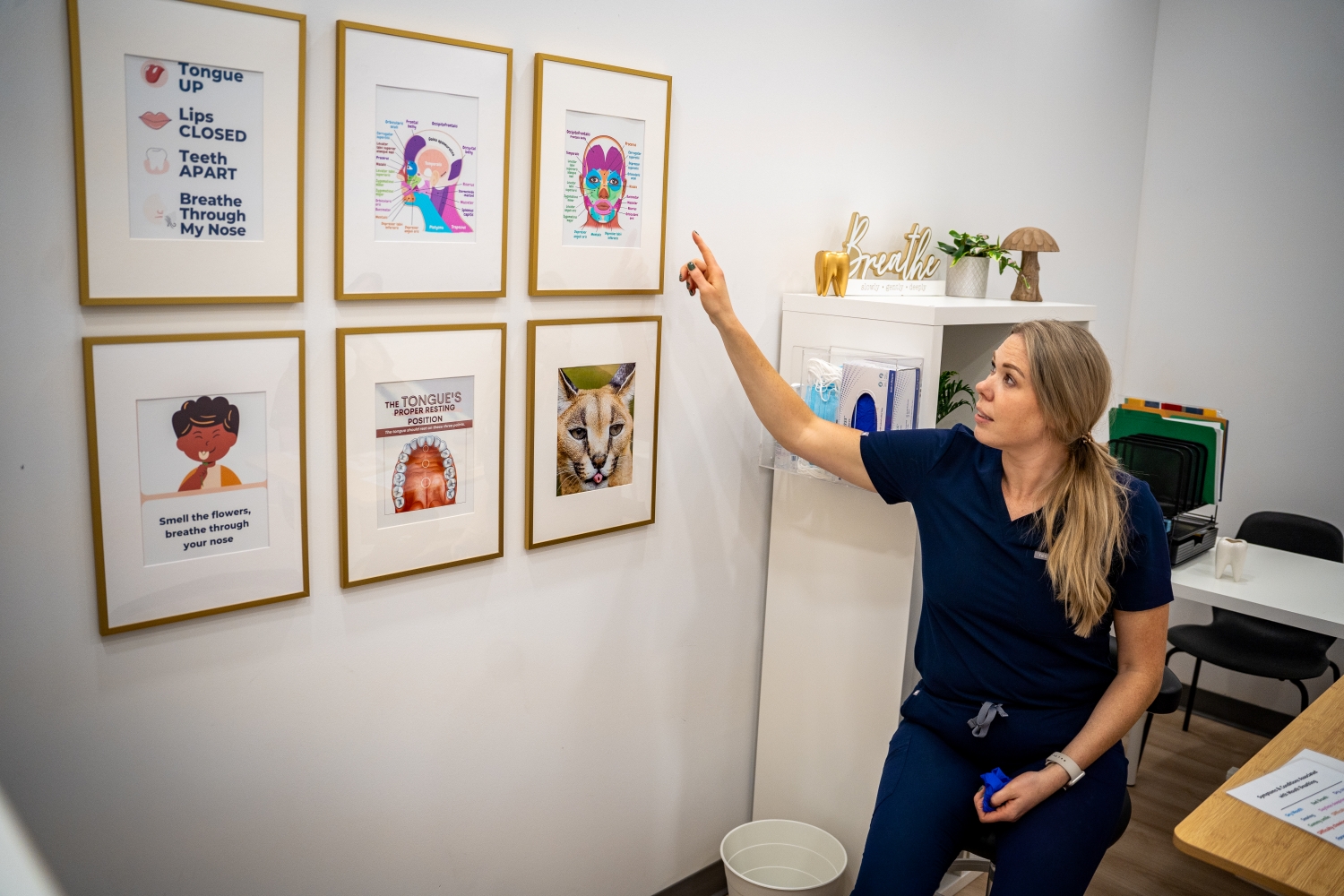
Establishing proper tongue resting posture is a primary focus of myofunctional therapy. Treatment helps patients develop awareness of where their tongue rests and retrains the tongue to rest comfortably against the palate, rather than low in the mouth or against the teeth.
Developing a relaxed, closed-lip resting posture without excessive muscle strain. Therapy focuses on improving lip awareness, strength, and coordination while addressing habits such as habitual open-mouth posture and unnecessary lip tension.
Identifying tongue thrust, compensatory muscle movements, and inefficient swallowing habits. Through targeted exercises, therapy focuses on retraining the tongue and surrounding muscles to develop a coordinated, functional swallowing pattern without excessive lip or facial muscle involvement.
Recognizing mouth-breathing habits and understanding the importance of a clear nasal airway. When nasal breathing is medically appropriate and unobstructed, therapy focuses on developing consistent nasal breathing habits and supporting functional tongue and lip resting posture.
Frequent mouth breathing, sleeping with the mouth open, snoring, restless sleep, or difficulty keeping the lips comfortably closed. These signs may be associated with nasal obstruction, altered oral resting posture, or sleep-related breathing concerns and may warrant further evaluation.
A tongue that rests low in the mouth, pushes against the teeth, or has difficulty resting comfortably against the palate. Restricted tongue mobility, sometimes associated with a tongue-tie, may affect swallowing, speech, or other oral functions. Not all tongue-ties require treatment.
Tongue thrusting during swallowing, excessive lip or facial muscle movement, difficulty chewing, messy eating, or certain speech articulation concerns. These patterns may indicate difficulties with tongue coordination and oral muscle function that could benefit from further assessment.
Persistent thumb or finger sucking, prolonged pacifier use, nail biting, open-mouth posture, or tongue pressure against the teeth. Certain oral habits and tongue patterns may contribute to changes in tooth position or interfere with orthodontic stability, making early identification important.

Your myofunctional therapy journey begins with a detailed assessment of your tongue resting posture, tongue mobility, lip posture, swallowing patterns, oral habits, and orofacial muscle function. We also review relevant health history, including concerns related to mouth breathing, sleep, and oral development.
Based on your assessment, we'll develop an individualized exercise program focused on improving tongue posture, muscle coordination, swallowing function, and healthy oral habits. Each session builds on your progress, introducing new exercises and helping you incorporate these patterns into everyday life.
Most patients begin with a recommended series of six sessions, although treatment is tailored to individual needs and progress. When appropriate, myofunctional therapy may be provided alongside care from dentists, orthodontists, physicians, sleep specialists, and other healthcare professionals.
Supporting better oral function through collaborative care.
At SMiiL Heights, we welcome referrals from dentists, orthodontists, dental hygienists, physicians, speech-language pathologists, and other healthcare professionals for children and adults with orofacial myofunctional concerns.
Our individualized therapy program focuses on tongue resting posture, lip closure, swallowing patterns, and oral muscle coordination. We work collaboratively with referring providers to support functional improvements and coordinated patient care.
To refer a patient, please complete our secure referral form below. Relevant clinical findings, radiographs, and intraoral photographs may be included to help guide the initial assessment.
Questions about a referral? Contact us at 587-287-2802.

The clinic is easy to find with street-level access, just north of the main office lobby. You can park for free in the underground lot or in a few spots at street level.


